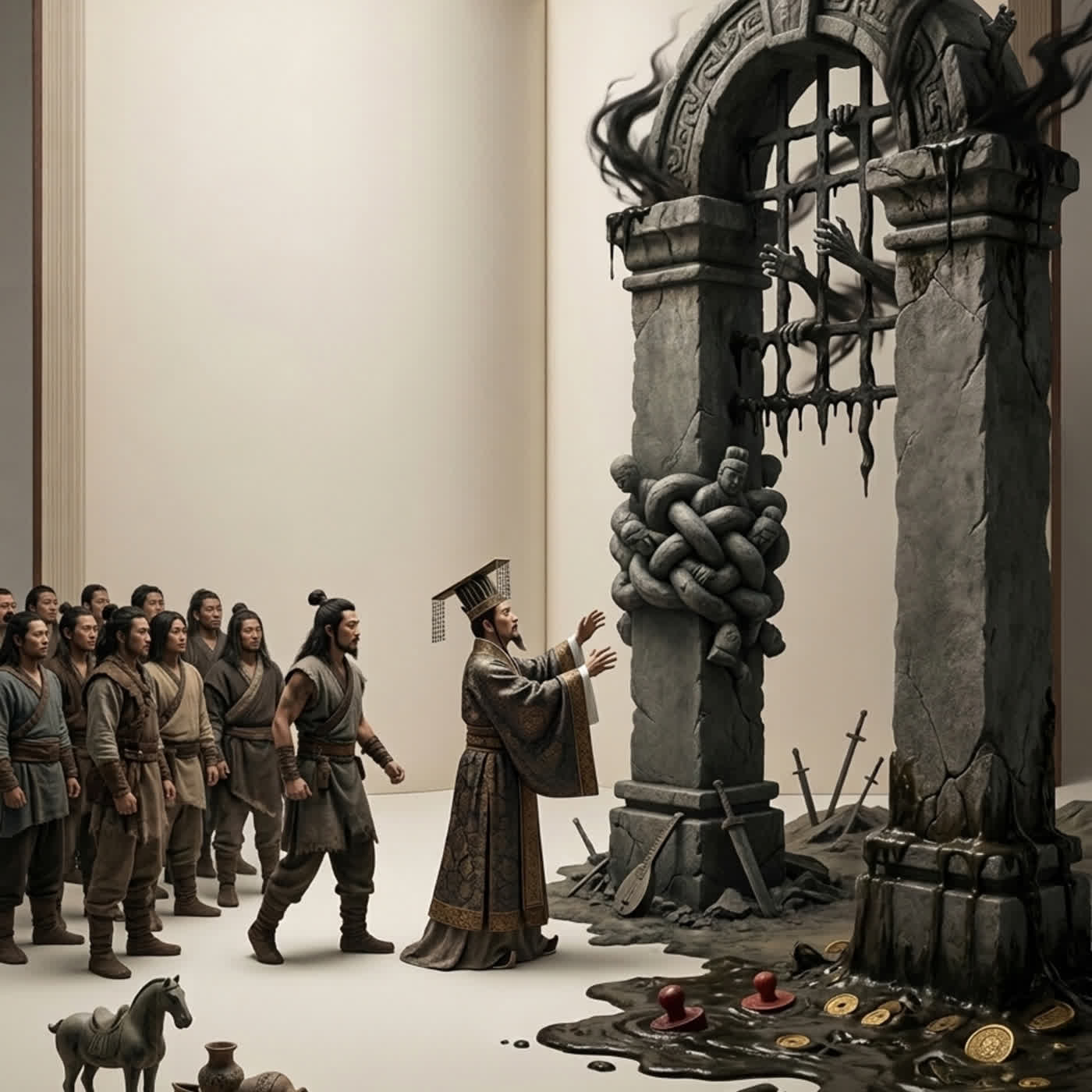
The "Soy Paste Vat" Trap: Why One of History’s Greatest Empires Traded Freedom for Corruption
Reviewing Chinese history with systems analysis
Available Platforms




Description
The Bo Yang Critique: Volume 17 of Zizhi Tongjian Jishi Benmo
In his biting historical commentary, Bo Yang explores the downfall of the Xianbei people. Originally, they were a powerful, nomadic force defined by an egalitarian "Meritocracy." In their early days, your ability spoke for you. There were no salaries; officials lived off the land, and the tribe survived as a collective "village" where everyone had a duty.
But then, they looked at China—and they fell for the wrong things.
🛑 The Three Toxins of "Sinicization"
Bo Yang argues that the Xianbei didn't adopt Chinese art or deep philosophy; they adopted the "easier" shortcuts to power:
From Merit to the Clan System (門閥): Nomadic life was fair—if you were capable, you led. However, the "Selfish Gene" took over. The Xianbei adopted the Clan System as an excuse to hoard wealth and power for certain families, creating a vertical hierarchy that killed the spirit of the tribe.
Ritual as a Weapon of Control (禮教): They took Confucianism—originally a guide for harmony—and turned it into an evil tool for manipulation. These "Oppressive Rituals" were used to force submission and make the common people easier to manage.
The Ultimate "Free Lunch" (Corruption): The Xianbei learned that using government power to take from others was "easy and highly profitable." They traded their self-sufficient nomadic roots for a complex system of bribery and extortion.
🐎 The Mongolian Exception: Survival via Resistance
Why is there still a country called Mongolia today, but no "Xianbei-land"? Bo Yang offers a controversial theory: The Mongols were the only ones who resisted being dissolved in the "Soy Paste Vat" of Chinese bureaucracy. When they could no longer rule, they simply retreated to the steppe, preserving their identity rather than being absorbed and extinguished by the culture they conquered.
🧠 The Modern Takeaway: The "Dirty Word" Theory
The most profound part of this analysis is why this happens. Just as children often pick up "dirty words" in a new language first because they are high-impact and easy to learn, the Xianbei picked up the "ugly" parts of Chinese culture first.
The Lesson for Us Today:
Ease is a Trap: The "bad" parts of a system—corruption, shortcuts, and power-tripping—are always easier to learn than the virtues.
Beware what you admire: When we learn a new skill or join a new culture, we must be extremely cautious. If we only adopt the "easy" benefits without the "hard" discipline, we don't just lose our way—we risk extinction.
The Bo Yang Critique: Volume 17 of Zizhi Tongjian Jishi Benmo
In his biting historical commentary, Bo Yang explores the downfall of the Xianbei people. Originally, they were a powerful, nomadic force defined by an egalitarian "Meritocracy." In their early days, your ability spoke for you. There were no salaries; officials lived off the land, and the tribe survived as a collective "village" where everyone had a duty.
But then, they looked at China—and they fell for the wrong things.
🛑 The Three Toxins of "Sinicization"
Bo Yang argues that the Xianbei didn't adopt Chinese art or deep philosophy; they adopted the "easier" shortcuts to power:
From Merit to the Clan System (門閥): Nomadic life was fair—if you were capable, you led. However, the "Selfish Gene" took over. The Xianbei adopted the Clan System as an excuse to hoard wealth and power for certain families, creating a vertical hierarchy that killed the spirit of the tribe.
Ritual as a Weapon of Control (禮教): They took Confucianism—originally a guide for harmony—and turned it into an evil tool for manipulation. These "Oppressive Rituals" were used to force submission and make the common people easier to manage.
The Ultimate "Free Lunch" (Corruption): The Xianbei learned that using government power to take from others was "easy and highly profitable." They traded their self-sufficient nomadic roots for a complex system of bribery and extortion.
🐎 The Mongolian Exception: Survival via Resistance
Why is there still a country called Mongolia today, but no "Xianbei-land"? Bo Yang offers a controversial theory: The Mongols were the only ones who resisted being dissolved in the "Soy Paste Vat" of Chinese bureaucracy. When they could no longer rule, they simply retreated to the steppe, preserving their identity rather than being absorbed and extinguished by the culture they conquered.
🧠 The Modern Takeaway: The "Dirty Word" Theory
The most profound part of this analysis is why this happens. Just as children often pick up "dirty words" in a new language first because they are high-impact and easy to learn, the Xianbei picked up the "ugly" parts of Chinese culture first.
The Lesson for Us Today:
Ease is a Trap: The "bad" parts of a system—corruption, shortcuts, and power-tripping—are always easier to learn than the virtues.
Beware what you admire: When we learn a new skill or join a new culture, we must be extremely cautious. If we only adopt the "easy" benefits without the "hard" discipline, we don't just lose our way—we risk extinction.